March 3, 2026
Interview with tyswan slater
Tyswan Slater was the TAFE recipient of an emerging membership with MTNS MADE. In conversation with Kevina-Jo Smith.
Tell us about your experience studying Visual Arts at Katoomba TAFE
I started studying part time as a way to provide routine and focus whilst I was recovering from my chronic illness. I began the Fundamentals of Design (Visual Arts) course in with the hope of producing an illustration portfolio, but the cohort of other students were very inspiring, and at times I was disappointed that I wasn’t pushing myself harder to produce fine art. It was during this process that my love of painting and creating art was reignited.
When the opportunity to do further study in a Certificate III in Visual Arts was offered, I decided to commit myself to exploring art for myself, and less as a path to employment. I began pushing my personal boundaries and moving beyond the technical elements of the exercises and assignments, exploring new ideas, being ambitious in size, themes, and scope. I was fortunate that I had the space and time to devote to the course outside of class and came to TAFE determined to produce work with real artistic merit and try to find my voice as an artist in the process.
I really loved the experience of studying visual arts at TAFE. The teachers are all fantastic artists, encouraging, and good at nurturing different levels of abilities and talents. Several of my peers joined the course as part of giving themselves permission to be creative for the first time in many years, whilst others were school leavers exploring the next steps to pursue a life or career in art. Meeting other artists at similar levels to myself, with passion and a love of creativity was inspiring and supportive. I’d recommend the course to anyone interested in self-expression and exploring art in a more structured way. There are assignments, deadlines and requirements, so the course won’t suit everyone, but the discipline of producing work to a brief mirror many of the skills I will need to apply for exhibitions, complete commissions, or participate in group shows. The constraints of assignments also forced me of my comfort zone and triggered greater creativity. The course also provides exposure to a range of mediums, techniques, and approaches, and most students make surprising discoveries about themselves, their medium of choice, or their style.
Is there a favourite project that you worked on in your time at TAFE that helped you solidify wanting to be an artist?
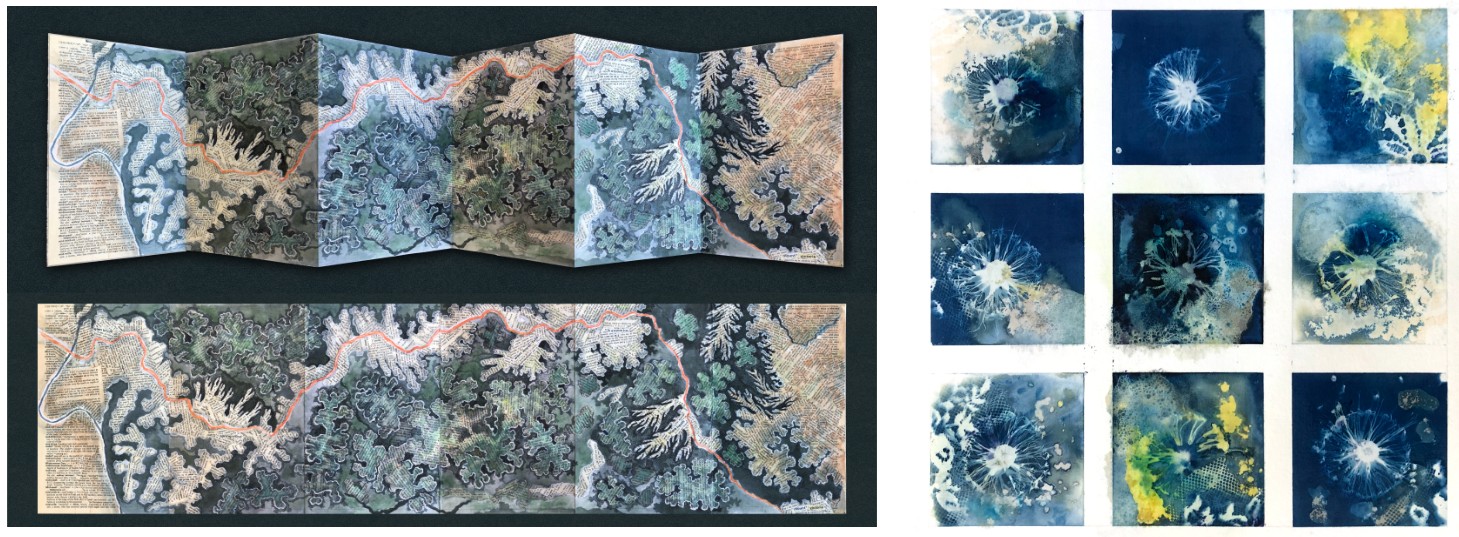
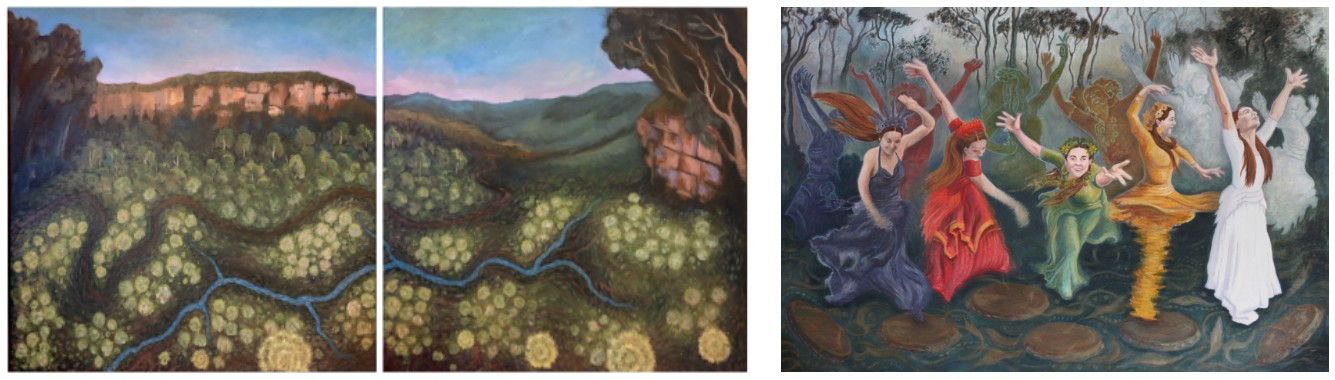
The collage concertina diary I produced in my drawing unit had a real impact on me, as it provided an interesting direction to develop my voice as an artist. Prior to this, I’d mainly experimented with canvas paintings in oil and acrylic, but this was the first time I really felt that the work was unique to me and not derivative of another artist’s style. I’d played around with the idea of lichen and maps before, but hadn’t considered implementing these ideas in collage, nor in such a small format. The work then seemed to flow. Additionally, the transcription exercise in the painting unit really connected me to the landscape work of William Robinson, and I later produced a work for a commission that blended the lichen maps and the unusual perspective work of Robinson, and this felt as if I’d found something that I could build on as an artist.
What are your favourite mediums to work with at the moment?
I’d always thought of myself as an oil painter, but I’m unexpectedly enjoying both collage and cyanotype. My collage work is intricate and detailed, typically using layers of blue-black ink, torn paper, posca pens,water colour, and permanent markers. The process is very exploratory, and although it’s based on real landscapes, there’s a large aspect of abstraction which for the first time provides a framework for me to explore work whichisn’t driven by representation.
I’m also experimenting with the possibilities of cyanotype beyond the traditional photographic or documentary techniques, exploring a range of chemical reactions to create painterly effects and working with fabric. This too has a lot of abstract elements to the work and exploring symbolism and relationships between shapes in a way that I haven’t in my previous work.
What are you currently inspired by?
I’m really finding inspiration in ambitious fabric art installations. Large scale conceptual pieces using a completely new medium is very exciting. I also appreciate the embodied physicality of textiles, and feel that in the digital age, the experiential aspect of the medium feels relevant in an age where so much content is consumed on a screen and at a physical distance from the actual artwork. This is very much a departure from my previous practice, needing to take into consideration how the artwork interacts with light and movement, and how best to mount the work.
Looking at the work of textile artists around the world, it’s clear that there is a whole world of tradition that I have so far been ignorant of. There are so many inspiring ways to approach the medium and create a visceral response to physical spaces.
I’m also exploring landscape in a different way, and I’m particularly inspired by landscape artists who play with perspective, scale and view point. This includes William Robinson, Andrew Levitsky, and Clifton Pugh.